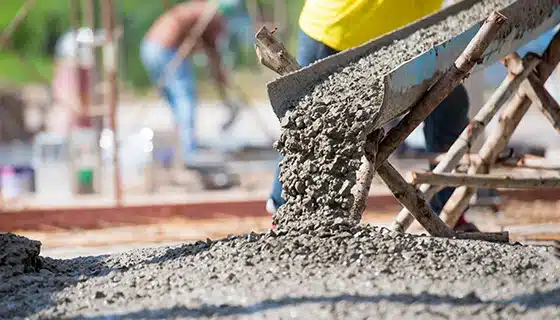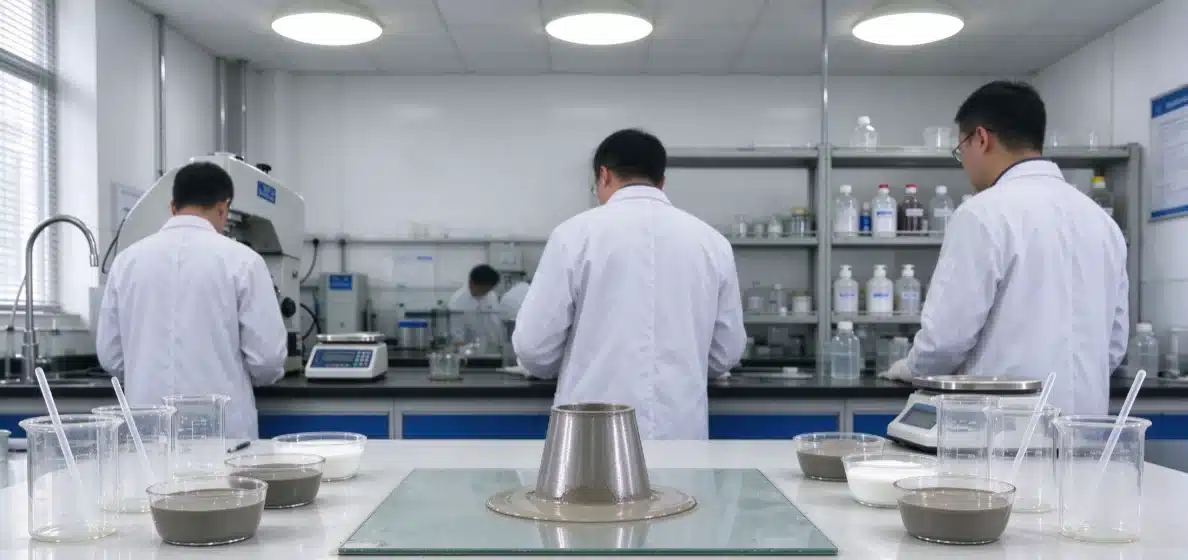







I. Introduction: Why Does Concrete Bleed or Segregate?
Bleeding and segregation are common workability problems during the production, transport, and placement of ready-mixed concrete. They can affect the uniformity, pumpability, and surface quality of fresh concrete. If not properly addressed, they may also increase the risk of localized defects, uneven strength, and reduced durability in hardened concrete.
Good flowability does not necessarily mean good stability. Even when a concrete mix has a high slump and flows easily, bleeding and segregation may still occur if the mortar lacks cohesion or the aggregate grading is unsuitable.
In practice, these problems are generally associated with raw material quality, mix design, admixture performance, and production and transport management. The following sections examine nine common causes and provide practical troubleshooting guidance.
II. What Is the Difference Between Concrete Bleeding and Segregation?
1. Concrete Bleeding
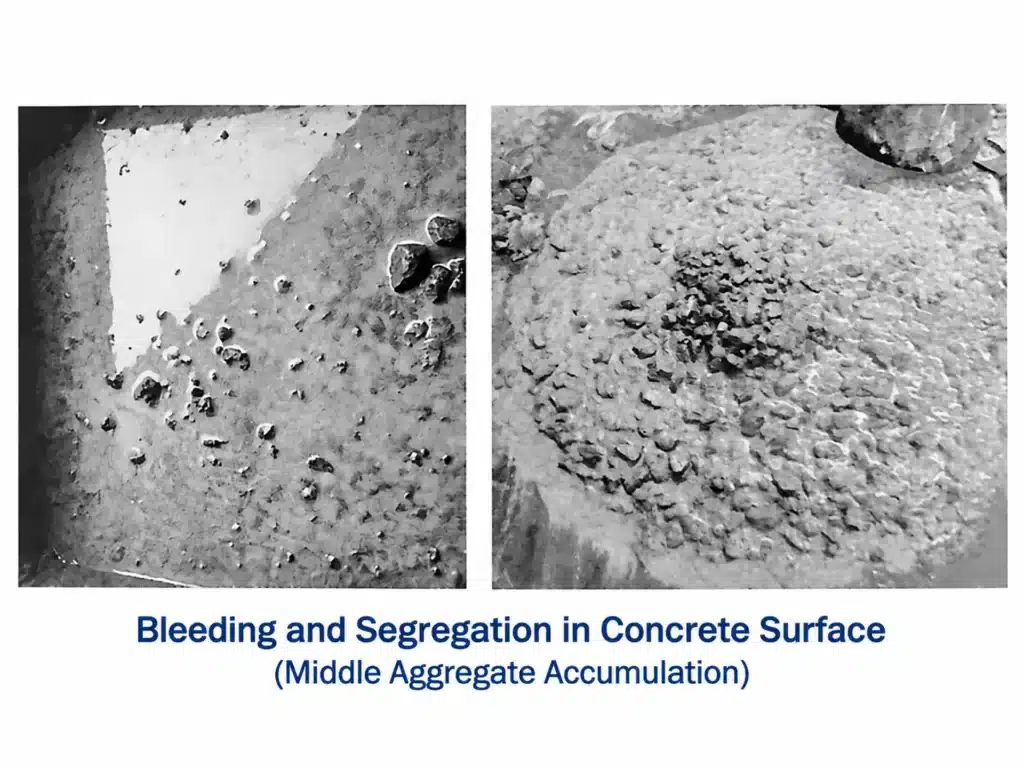
Bleeding occurs when solid particles in fresh concrete settle under gravity, causing some of the water to migrate upward and form free water on the surface. Common signs include:
- Standing water or a film of water on the concrete surface;
- Localized water channels, water pockets, or laitance;
- A weak surface paste layer, potentially leading to dusting or surface abrasion;
- Uneven water distribution, potentially increasing the risk of localized defects and cracking.
2. Concrete Segregation
Segregation occurs when the constituents of fresh concrete become unevenly distributed or separate from one another. Common signs include:
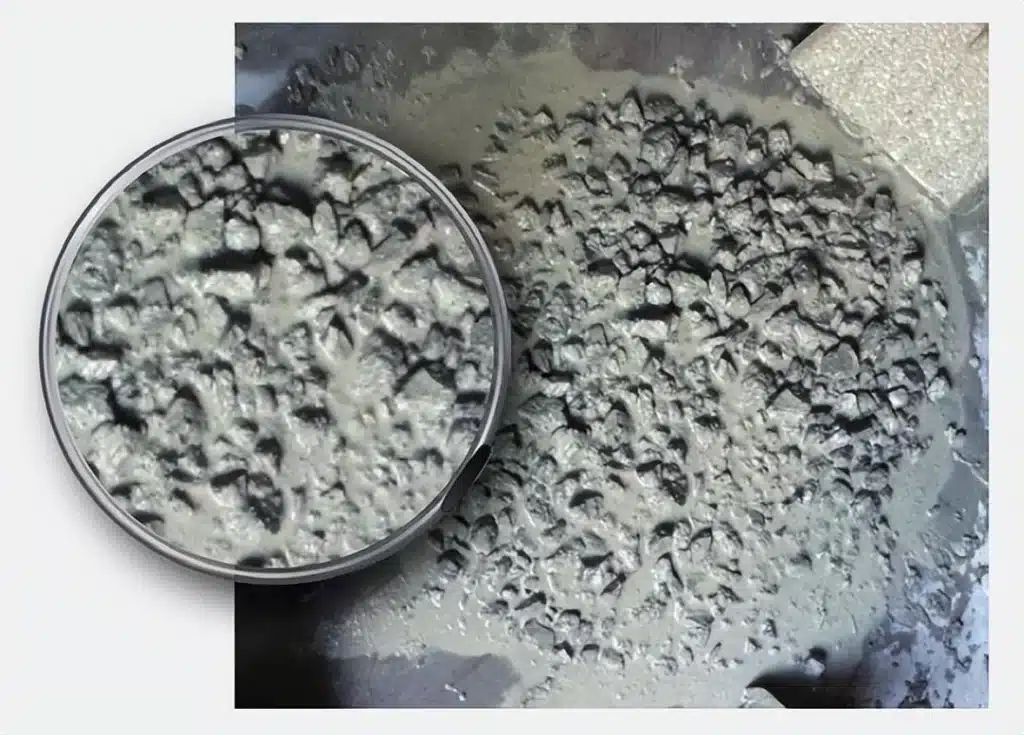
- Visible separation of coarse aggregate from mortar;
- Concentrated deposits of coarse aggregate and insufficient mortar in certain areas;
- Layering, aggregate settling, or stone accumulation in the mix;
- Fluctuating workability during pumping and, in severe cases, an increased risk of pipeline blockage.
Bleeding and segregation are related but not identical. Bleeding mainly involves water separating from the mix, whereas segregation involves the uneven distribution of aggregates, mortar, and other constituents. They may occur together or independently.
III. Nine Common Causes of Concrete Bleeding and Segregation—and Their Solutions
Cause 1: Insufficient Sand Content or Poor Sand Grading
Sand fills the voids between coarse aggregate particles and helps form a continuous, stable mortar structure. When the sand proportion is too low or the sand lacks fine particles, mortar volume and cohesion may be insufficient. Coarse aggregate can then settle more easily, resulting in bleeding or segregation.
Recommended Checks and Corrective Actions:
- Check the actual sand proportion, sand fineness modulus, and particle-size distribution.
- Gradually adjust the sand proportion through trial mixes, taking coarse aggregate grading and target workability into account.
- Where necessary, blend sands from different sources to improve the fine-particle distribution.
- Do not increase sand content by a fixed amount based on experience alone; monitor slump, bleeding rate, and segregation at the same time.
Cause 2: Excessive Clay or Harmful Fines in Aggregates
Clay and harmful fine particles can increase water demand and affect the compatibility of cement with polycarboxylate ether (PCE) water reducers. Some clay minerals adsorb PCE molecules, reducing effective dispersion and causing fluctuations in water-reducing efficiency, slump retention, and workability stability.
Recommended Checks and Corrective Actions:
- Test the clay and clay-lump content of aggregates in accordance with applicable standards.
- Wash, screen, or replace nonconforming aggregates where necessary.
- Repeat PCE compatibility testing whenever raw materials are changed or show significant variation.
- Monitor changes in water reducer dosage; simply increasing the dosage may conceal underlying raw material problems.
Cause 3: Insufficient Binder Content or Paste Volume
Paste formed by cement and supplementary cementitious materials must coat the aggregates and fill the spaces between them. If the total binder content or paste volume is insufficient, the mortar may not provide adequate coating and lubrication, leading to poor cohesion, aggregate settlement, or segregation.
Recommended Checks and Corrective Actions:
- Review total binder content, paste volume, and water-to-binder ratio.
- Optimize paste composition according to strength grade, aggregate grading, and construction requirements.
- Evaluate the suitability of supplementary cementitious materials such as fly ash and ground granulated blast-furnace slag.
- After adjustment, verify properties including strength, setting time, bleeding, and shrinkage.
Cause 4: Unsuitable Coarse Aggregate Grading
Gap-graded coarse aggregate or aggregate with an overly narrow particle-size range may create larger voids in the aggregate skeleton. If the mortar volume and composition cannot adequately fill these voids, the concrete may have insufficient aggregate coating and become prone to segregation.
Recommended Checks and Corrective Actions:
- Check sieve analysis results and grading for aggregates of different sizes.
- Optimize the proportions of different coarse aggregate sizes to achieve a reasonably continuous grading.
- Adjust the mix holistically, considering aggregate void content, sand proportion, and paste volume.
- Avoid making major changes to sand or coarse aggregate proportions without trial mixes.

Cause 5: Excessive Mixing Water or Uncontrolled Water Addition on Site
Excessive water content increases free water in the mix, reduces paste cohesion, and raises the risk of bleeding. Adding water indiscriminately during transport or at the jobsite also changes the original mix proportions and water-to-binder ratio, reducing concrete stability.
Recommended Checks and Corrective Actions:
- Control mixing water accurately and correct for the moisture content of sand and coarse aggregate.
- Use a suitable PCE water reducer to achieve target flowability instead of adding extra water as a substitute for mix optimization.
- Do not add water to the mixer truck or at the jobsite without technical authorization.
- Check slump, slump flow, bleeding, and segregation together.
Cause 6: Incorrect PCE Dosage or an Unsuitable Product Formulation
PCE improves concrete flowability by dispersing cement particles, but a higher dosage is not always better. Overdosing, a mismatch between water-reducing capacity and the mix, or poor compatibility with cement and supplementary cementitious materials can cause excessive slump, unstable workability, or inadequate stability. Slump-retaining, air-entraining, retarding, and thickening components in the admixture can also affect the final result.
Recommended Checks and Corrective Actions:
- Determine the appropriate dosage through trial mixes, taking actual solids content and effective dosage into account.
- Evaluate water-reduction rate, initial slump, slump loss over time, and bleeding together.
- Assess Polycarboxylate superplasticizer compatibility with the cement and supplementary cementitious material system.
- If needed, ask admixture specialists to adjust the molecular structure or blended formulation.
- Do not assume that adding thickeners or air-entraining agents will solve every segregation problem.
Cause 7: Variations in Cement and Supplementary Cementitious Material Quality
Cement type, fineness, mineral composition, and storage condition affect water demand, setting behavior, and admixture compatibility. Changes in the fineness, loss on ignition, reactivity, or water demand of fly ash and slag powder can also lead to variations in concrete workability.
Recommended Checks and Corrective Actions:
- Strengthen incoming inspections and batch traceability for cement, fly ash, and slag powder.
- Check for moisture exposure, caking, and excessive cement storage time.
- Test fly ash fineness, loss on ignition, water-demand ratio, and other relevant indicators.
- Verify concrete performance and admixture compatibility promptly after raw material batch changes.
Cause 8: Mismatch Between Setting Time and Retarding Performance
Some concrete mixes appear normal immediately after mixing but develop delayed bleeding during transport or after standing. Possible factors include cement hydration characteristics, ambient temperature, retarding components, binder composition, and static stability. Excessive retardation may extend the period during which particles settle and water migrates.
Recommended Checks and Corrective Actions:
- Set an appropriate setting time based on transport distance, construction schedule, and ambient temperature.
- Check compatibility between the retarding components in the PCE product and the cement system.
- Conduct standing observations and time-dependent bleeding tests rather than checking only the freshly discharged mix.
- Adjust retarding components if necessary, while verifying slump retention and setting time.
Cause 9: Poor Control of Batching, Mixing, or Transport
Batching errors, failure to correct aggregate moisture, inadequate mixing, or residual water in transit mixer drums can change actual mix proportions or make the concrete nonuniform. Site management issues are sometimes mistaken for admixture quality problems.
Recommended Checks and Corrective Actions:
- Regularly inspect and calibrate the batching systems for water, sand, coarse aggregate, binders, and admixtures.
- Adjust production water based on the current moisture content of the aggregates.
- Control material charging sequence and mixing time according to process requirements.
- Drain residual water from mixer trucks before loading and manage mixing during transport properly.
- Check concrete workability as required at plant dispatch, site arrival, and before placement.
IV. How Can PCE Water Reducers Improve Concrete Workability?
Polycarboxylate ether (PCE) مخفف الماء are widely used high-performance admixtures in modern ready-mixed concrete. They affect not only water demand and flowability but also slump retention, paste condition, and placing performance through interactions with cement and supplementary cementitious materials. To address bleeding and segregation, focus on the following aspects.
1. Balance Water Reduction and Concrete Stability
Efficient water reduction can lower mixing water while meeting the target flowability. In practice, however, maximizing water reduction or slump alone is not enough. Cohesion, bleeding, and segregation must also be evaluated. A suitable PCE product should match the specific binder system and mix design.
2. Pay Attention to Slump Retention
Slump retention is particularly important for projects involving long transport distances, hot weather, or extended waiting times. A properly selected slump-retaining PCE helps maintain required workability during transport and waiting, reducing the likelihood of additional water being added on site. However, slump retention does not necessarily mean resistance to bleeding; this must still be verified through standing and time-dependent tests.
3. Evaluate Paste Cohesion and Water Retention
Concrete stability depends on multiple factors, including paste volume, fine-particle composition, aggregate grading, and the admixture system. Where necessary, optimizing the PCE formulation and concrete mix can improve paste cohesion and aggregate coating. The use of thickening or air-entraining components should be validated through testing, with attention to air content, strength, and durability.
4. Test Compatibility with Cement and Supplementary Cementitious Materials
Cement, fly ash, and slag powder can vary across regions and production batches. Good PCE performance in one material system does not guarantee identical results in every system. Tests using the customer’s actual raw materials are recommended, including cement paste, mortar, and concrete tests to assess water reduction, slump retention, setting time, bleeding, and strength.
V. On-Site Troubleshooting Checklist for Batching Plants
When concrete bleeds or segregates, check the following items one by one and record changes immediately after mixing, on arrival at the site, and after standing.
| Inspection Item | Key Checks |
| Sand | Sand proportion, fineness modulus, particle grading, clay content, and moisture content |
| Coarse Aggregate | Particle-size distribution, continuous grading, clay content, and flaky or elongated particles |
| Binder Materials | Cement type and batch, total binder content, and supplementary cementitious material quality |
| Mixing Water | Actual water addition, corrections for aggregate moisture, and any additional water added on site |
| PCE Water Reducer | Product grade, dosage, solids content, water-reduction rate, and slump retention |
| Admixture Compatibility | Compatibility with cement and supplementary cementitious materials, setting time, and bleeding |
| Batching and Mixing | Batching equipment condition, charging sequence, and mixing time |
| Transport | Residual water in mixer trucks, transport duration, mixing condition, and waiting time |
| On-Site Placement | Slump or slump flow, bleeding, segregation, pumping, and placing conditions |
Technical Note: Do not attempt to solve bleeding and segregation simply by increasing sand content, binder content, or thickening components without trial verification. Assess raw materials, mix design, concrete workability, and construction conditions together.
VI. MIKUR PCE Water Reducers and Concrete Application Support
MIKUR specializes in concrete admixtures and related materials, with a focus on polycarboxylate ether (PCE) water reducers. Products are available in powder, tablet, and liquid forms. Selection and application evaluation can be tailored to different concrete systems, production processes, and construction requirements.
For ready-mixed concrete, precast concrete, high-performance concrete, and other cement-based materials, PCE selection should consider the target water-reduction rate, slump-retention requirements, cement and supplementary cementitious material characteristics, transport time, and construction environment.
MIKUR Product Application Options
- PCE1701: Can be evaluated for water reduction and flowability adjustment according to mix design requirements; actual performance should be confirmed through trial mixes.
- PCE570: Intended for concrete applications requiring slump retention; performance should be verified against the cement system and transport conditions.
- PCE1000T: A slow-release tablet product that can be evaluated for applications requiring extended workability retention. Actual release behavior and performance depend on the cement system, alkaline environment, temperature, and formulation.
MIKUR values product quality, raw material compatibility, and application feedback. We welcome discussions with concrete producers and admixture partners worldwide to evaluate suitable products and formulation solutions for real-world applications.
VII. Frequently Asked Questions (FAQ)
What causes concrete bleeding?
Common causes include excessive mixing water, insufficient sand content, inadequate fines, insufficient paste volume, poor aggregate grading, and compatibility issues involving cement and admixtures. Investigate raw materials and mix proportions systematically.
How can concrete segregation be corrected?
First determine whether poor stability comes from aggregate grading, mortar volume, water content, or admixtures. Check the sand proportion, paste volume, and PCE dosage, then verify adjustments through trial mixes. Adding water or powdered materials indiscriminately on site is not recommended.
Can PCE water reducers cause concrete bleeding?
In certain mix designs and material systems, bleeding or segregation may occur if the PCE dosage is excessive, its water-reducing capacity is unsuitable, or the paste and aggregate structure is poorly balanced. The symptoms alone do not prove that the water reducer is the sole cause.
Why does concrete bleed after transport even though it looks normal when discharged from the plant?
Possible factors include sand proportion and grading, fine-particle composition, degree of retardation, static stability, residual water in mixer trucks, and transport conditions. Check both the initial condition and changes over time after standing.
Can increasing sand content solve concrete segregation?
It can sometimes improve cohesion, but it is not suitable in every case. Excessive sand content may increase water demand or impair flowability. Trial mixes should consider aggregate grading and paste volume together.
VIII. Conclusion
Concrete bleeding and segregation are usually caused by multiple factors rather than a single issue. Raw material quality, mix design, PCE water reducer performance, batching accuracy, and transport and construction management all affect the stability of fresh concrete.
Effective quality control starts with raw material testing and mix optimization, followed by concrete trials to verify admixture compatibility. For batching plants, monitoring and recording concrete conditions from discharge through placement can help identify the source of problems more quickly.
MIKUR | Materials that make a difference
Contact MIKUR to discuss PCE water reducers and technical solutions for concrete applications.